DevOps as a Service — Our specialists are here to help you!

The right combination of software and hardware is crucial for a secure and high-performance infrastructure.

Our DevOps specialists are happy to provide you with the expertise you need—whether to take the strain off your own IT department or so you don’t have to maintain your own resources in-house.

Learn more about the benefits of DevOps as a Service for you and your company’s success!

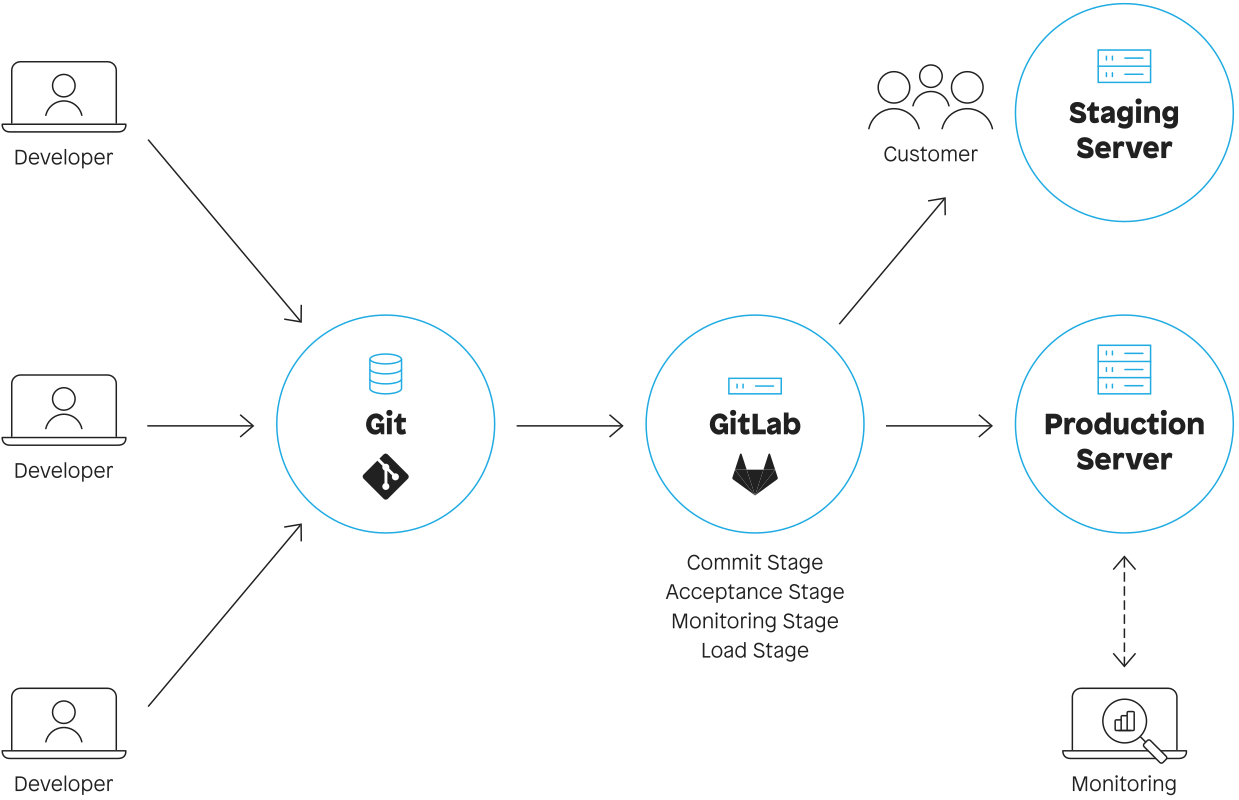
Deployment_Infrastructure-Overview_Infra

A selection of the areas our DevOps specialists cover for you:

If you have any questions about our services or the individual topics, please feel free to contact us. We’ve also explained these terms in more detail for you in the “DevOps in a nutshell” section.

DevOps in a nutshell:

Continuous Integration (CI) & Continuous Delivery (CD)

Continuous Integration (CI) and Continuous Delivery (CD) are practices in the fields of software development and DevOps that aim to optimize the development and deployment process.

Continuous Integration (CI):

  • CI refers to the practice of regularly integrating code changes into a shared repository.
  • Developers frequently commit small code changes to the version control system.
  • A CI server monitors the repository and runs automated builds and tests to ensure that new changes do not break existing functionality.
  • CI helps detect conflicts early on and ensures that the code remains in a consistent and executable state.

Continuous Delivery (CD):

  • CD expands on the concept of CI and refers to the automatic deployment of software across various environments, including production environments.
  • After successful integration and testing in the CI process, the software is automatically prepared for deployment.
  • The CD process can continue all the way through automated deployment to production environments, thereby shortening time-to-market.
  • CD enables reliable and repeatable software deployment.

In summary, CI and CD promote automation, consistency, and efficiency in the software development lifecycle, enabling development teams to become more agile and deliver high-quality software faster and more reliably.

Microservices

Microservices are an architectural approach to developing software applications in which an application is broken down into smaller, independent services.

Each of these services, also known as microservices, performs a specific function and can be developed, implemented, scaled, and updated independently of one another. This decentralized structure enables greater agility, flexibility, and scalability in software development, as changes to one microservice do not affect other parts of the application.

By using microservices, development teams can respond more quickly to changes, simplify maintenance, and improve the application’s overall reliability and scalability.

Infrastructure as Code (IaC)

Infrastructure as Code (IaC) is a method used in software development and DevOps in which the infrastructure required to deploy and run applications is described and managed using dedicated scripts or configuration definitions.

Instead of using manual processes or graphical user interfaces, the infrastructure is defined using code that is stored and managed in version control systems.

By using IaC, DevOps teams can automate infrastructure, ensure repeatable and consistent deployments, and respond more quickly to changes.

This enables more efficient resource management, improved scalability, and the ability to treat infrastructure like application code, thereby bridging the gap between development and operations (Ops). IaC contributes to the agility, security, and reliability of IT infrastructures.

Service Monitoring

Service monitoring refers to the proactive monitoring and analysis of IT services to ensure they operate efficiently and reliably. In the DevOps world, service monitoring plays a critical role in ensuring the availability, performance, and health of applications and services. Here are some key aspects:

  • Real-time monitoring: Continuous, real-time monitoring to immediately detect and respond to issues. This includes aspects such as server performance, network connectivity, database response times, and more.
  • Fault Detection and Resolution: Identifying errors and disruptions in a service. Service monitoring enables proactive troubleshooting before users experience any negative effects.
  • Performance Monitoring: Tracking the performance of applications and services to identify bottlenecks or inefficient resource usage. This helps optimize the infrastructure and ensure efficient resource utilization.
  • User experience: Monitoring the user experience to ensure that services meet user expectations. This may include monitoring load times, response times, and other user-relevant metrics.
  • Log Analysis: Analyzing logs and events to identify potential issues and understand behavioral patterns. This is important for gaining deeper insights into the root causes of problems.
  • Alerts and Notifications: Setting up alerts and notifications to quickly inform teams of potential issues and enable a rapid response.

Service monitoring helps ensure the availability, reliability, and performance of IT services, which is crucial for guaranteeing a positive user experience and minimizing downtime.

Automated Testing

Automated testing is a practice in software development and the DevOps approach that involves using specialized software tools to perform repeatable and predictable tests on software applications. The purpose of automated testing is to ensure the quality and stability of software during the development process.

In summary, automated testing involves:

  • Automation of test cases: The definition and implementation of test cases that can be executed automatically by testing tools. These test cases verify various aspects of the software, such as functionality, performance, security, and usability.
  • Repeatability: The ability to run tests repeatedly to ensure that existing functionality continues to work as expected and to ensure that new changes do not have any unintended effects.
  • Speed and efficiency: Automated tests can be run faster than manual tests, thereby increasing development speed. This is particularly important in agile and DevOps environments, where frequent code changes occur.
  • Early Detection of Bugs: By integrating automated tests into the continuous integration process, bugs and issues can be identified and resolved early in the development cycle.
  • Regression testing: Automating regression tests ensures that existing features continue to function correctly after code changes.
  • Scalability: Automated tests can be easily scaled to handle growing codebases and complex applications.

Automated tests help improve software quality, shorten development time, and ensure the reliability of applications by providing an efficient way to check software for bugs and unintended behavior.

Agile Software Development

Agile software development is an iterative and collaborative approach to software development that aims to respond flexibly to changes, better meet customer needs, and achieve higher productivity in the development process. Here are the core principles of agile software development:

  • Iterative development: The development process takes place in short, repeatable cycles called sprints. Each sprint includes planning, development, testing, and deployment of portions of the software.
  • Flexibility and Adaptability: Agile methods emphasize the ability to adapt to changing requirements. Teams can respond to customer feedback during the development process and adjust the direction of the project.
  • Collaboration and communication: Strong collaboration within the development team and with stakeholders to foster a shared understanding of requirements. Communication is considered crucial to success.
  • Incremental Delivery: The software is delivered in incremental steps, enabling early and regular deliveries of working software. This allows customers to see value early on.
  • Self-Organizing Teams: Agile teams are self-organizing and self-managing. Team members take on different roles and responsibilities to ensure efficient collaboration.
  • Continuous improvement: Through regular reviews and reflections after each sprint, the goal is to continuously improve the development process. This is often referred to as a retrospective.
  • Customer Focus: The needs and feedback of customers are central. Agile software development strives to deliver software that ensures the highest possible customer satisfaction.

Agile software development promotes an adaptive and responsive approach that is particularly well-suited for projects where requirements can change rapidly. Agile methods such as Scrum or Kanban are frequently used in DevOps environments to enable efficient software development and deployment.


Figure: contact person Daniel Lienert
DevOps as a Service for You!
Our specialists are here to help you so that you can focus on more important tasks.
Daniel Lienert
Managing Director, CTO
+49(0)721 91090
Contact now
$(“Best-Solution”).focus();
Anastasiia Zaieva, Entwicklung at punkt.de